The European LIFE FREESVEE project (“Fast recharging energy service everywhere on the road”) proposes high-level technological solutions for ultra-fast public charging of electric vehicles anywhere. This solution will eliminate the need for a high-power electrical grid to provide service, facilitating the transition to electric mobility in rural areas or areas with limited electrical infrastructure.
To demonstrate this solution, two demonstration prototypes will be implemented at two service stations (or electric charging stations) with different characteristics. On the one hand, the Miralbueno Service Station (Zaragoza) is located in an urbanized area, with a moderate power grid connection. The proposed solution will provide the electric charging station with ultra-fast charging capability without the need to increase the contracted power. On the other hand, the La Ladera Service Station (Soria), owned by Zoilo Ríos, is located in a sparsely populated area and has a low-power connection and occasional power outages. With the proposed solution, the electric charging station will be able to offer ultra-fast charging at any time without worrying about the weak grid connection. Both service stations will be configured as a microgrid incorporating renewable generation (photovoltaic system), energy storage (short-term, in lithium-ion batteries, and long-term, in vanadium redox flow batteries, to be installed at the La Ladera service station), ultra-fast EV chargers, and standard loads (lighting, air conditioning, etc.). For optimal energy management in the microgrid, a smart controller will be developed, which will save energy and costs while ensuring service at the charging station.
INTERGIA’s role in the project is to design and implement the microgrid for both prototypes, including the design of the control algorithms that will govern the energy optimization processes. These algorithms will take into account demand and photovoltaic generation forecasts, as well as the state of charge of the batteries and energy storage systems. Data will also be collected on the status and history of traffic and electricity prices in the market. The aim is to ensure that the charging station has sufficient energy at all times to serve the electric vehicles that come to recharge, and that this energy comes as far as possible from renewable sources and is as cheap as possible.
In addition to the prototypes, the project also includes an analysis of the technical, economic, and legislative characteristics necessary for the adoption of electric mobility at service stations across Europe. In this way, LIFE FREESVEE aims to solve an important problem for the rapid and comprehensive deployment of electric mobility as a way to mitigate climate change.

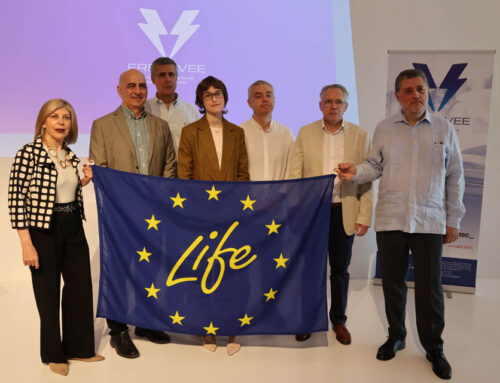
Initial project meeting between consortium partners, held in July 2025 in Zaragoza.

Electric truck charging at the Miralbueno Service Station (Zaragoza), using a charger installed by Intergia (prior to the development of the LIFE FREESVEE project).
The FREESVEE project began in July and work will continue until the end of 2028. It is coordinated by the Spanish National Research Council (CSIC) and involves the University of Zaragoza, SATEC, the Zoilo Ríos Group, and the Miralbueno Service Station.
FREESVEE is a project co-financed by the European Union under the LIFE Program, with a budget of €3,607,220.38 and has received funding of €2,164,332.23 (60%).

101213372 — LIFE24-CCM-ES-FREESVEE