
Fast recharging energy service everywhere on the road
Description
LIFE FREESVEE – «Fast Recharging EnErgy Service eVErywhEre on the road» addresses the transition to electric mobility, proposing high-level technological solutions for ultra-fast public charging of electric vehicles anywhere, eliminating the need for a high-power electrical grid to provide service.
The proposed solutions employ innovative techniques applicable to different charging point configurations, both grid-connected and stand-alone. Therefore, for demonstration purposes, two pilot prototypes will be implemented at two service stations with different characteristics in order to test and validate different technologies and configurations:
- The first prototype addresses the general case of a service station connected to the grid in an urbanized area. It demonstrates the optimal management of an ultra-fast EV charging station with a moderate connection to the power grid, without the need to increase it.
- The second prototype aims to demonstrate the possibility of ultra-fast EV charging at a service station with a weak network (low-power connection, with network outages or even no network at all) in a sparsely populated area.
Both prototypes will be configured as a microgrid incorporating renewable generation, short-term storage (in Li-ion batteries) and long-term storage (in the case of prototype 2, in a vanadium redox flow battery), ultra-fast EV charging, and the usual demand for charging at the service station. A smart controller will be developed for optimal energy management at both service stations. LIFE FREESVEE will also analyze the different configurations of service stations in order to identify their technical, economic, and legislative characteristics and address the challenges they face in adopting electric mobility. In this way, the project aims to solve an important problem for the rapid and complete deployment of electric mobility as a way to mitigate climate change.

Reference: LIFE24-CCM-ES-FREESVEE
Duration: 07/2025 – 09/2028
Programme: LIFE, Climate Action, Climate Change Mitigation
Financing body: LIFE Programme, CINEA
Total budget: 3,607,220.38€
EU Co-financing: 2,164,332.23€ (60%)
Technical Coordinator: Dr. Javier Carroquino
Project Director: Dr. Luis Valiño
Follow LIFE FREESVEE on social media
Demonstrative pilots
Miralbueno Service Station, Zaragoza

Ubicación: N-332, Av. de Logroño, 42, 50011 Zaragoza
Grid-connected service station in a built-up area.

Optimal management of an ultra-fast charging station for EVs with a moderate-capacity connection to the power grid, without the need for grid expansion.


La Ladera Service Station, Soria

Ubicación: AT A-2 P.K. 174,5 I, 42259 Montuenga de Soria, Soria
Grid-connected service station with low-power in a sparsely populated area.

Optimal management of an ultra-fast charging station for EVs with a weak-capacity connection to the power grid, power outages or even in the absence of a grid.


Members of the consortium
Coordinator entity



Project updates
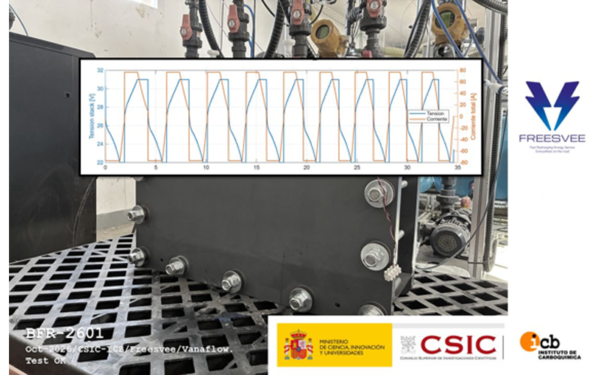
The BF26-01 stack, developed by the Electrochemical Devices and Fluid Dynamics Engineering Group (GIDEF) at the ICB-CSIC Institute of Carbochemistry, has successfully completed its bench testing phase. Over the course of four weeks, the stack accumulated more than 200 hours of testing, yielding the following results:
- Peak power of 3.07 kW DC during charging and 2.63 kW DC during discharging, with currents of up to 96 A.
- DC energy efficiency of up to 81.3% and coulombic efficiency of up to 95.5%, achieved in different cycles.
- Completely leak-proof: not a single leak was detected.
At the La Ladera service station (Arcos de Jalón, Soria), which is connected to a weak power grid, the project’s microgrid will combine lithium-ion batteries for power with a vanadium flow battery for long-term storage. This technology allows for separate scaling of power and energy, uses a non-flammable aqueous electrolyte, and its vanadium electrolyte is reusable.
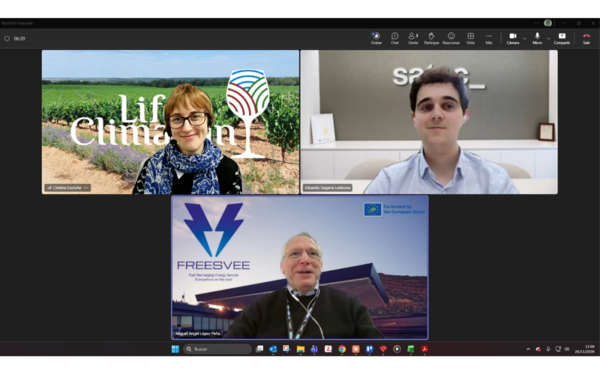
On November 26, 2026, a networking meeting was held between the LIFE CLIMAWIN and LIFE FREESVEE projects. Both projects involve the organizations CSIC and INTERGIA. LIFE FREESVEE applies knowledge gained in WP4 of LIFE CLIMAWIN on energy management in microgrids to the context of ultra-fast electric vehicle charging stations. During the meeting, the LIFE CLIMAWIN project was presented to colleagues from FREESVEE.
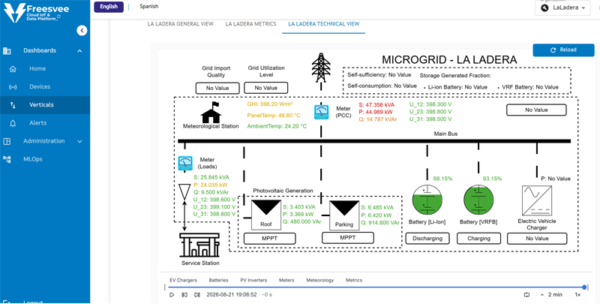
The first screenshots of the “FREESVEE Cloud IoT & Data Platform_”, developed by SATEC, are released. The platform covers the entire data and information lifecycle of the microgrid for charging stations. It provides intelligent data analysis services (based on AI) and applications as services. The system already offers monitoring, metric calculation, supervision, and alert management services.
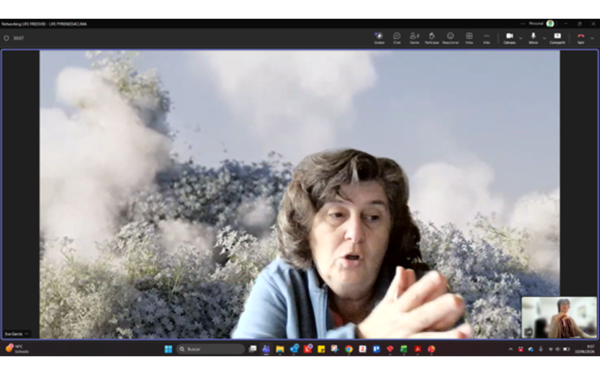
On June 10, 2026, a networking meeting was held between the LIFE PYRENEES4CLIMA and LIFE FREESVEE projects, with the goal of introducing the two projects to one another and exploring potential synergies. The LIFE Pyrenees4Clima project supports the development of the Pyrenean Climate Change Strategy (EPiCC) by promoting integrated adaptation and mitigation measures in the Pyrenees. During the meeting, the possibility of using FREESVEE technology to promote sustainable tourism travel was explored, as well as its application in other types of facilities, such as rural hotels, ski resorts, etc.
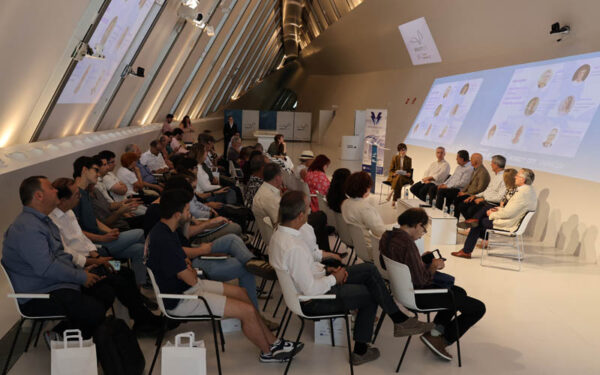
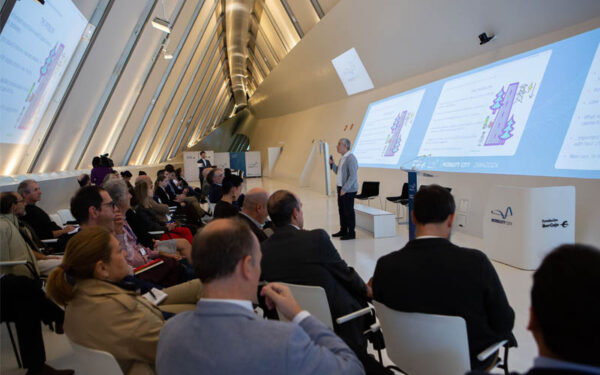
The official launch of the LIFE FREESVEE project took place on May 29 at the Mobility City venue in Zaragoza. The event, which brought together some fifty professionals from the mobility, energy, and industrial sectors, as well as electric vehicle users, consisted of a brief presentation and a roundtable discussion. The event began with an institutional welcome, during which Jaime Armengol, coordinator of Mobility City at Fundación Ibercaja; María Jesús Lázaro, institutional delegate of the CSIC in Aragon; and Miguel Ángel García Muro, Councilor for Digital Transformation at the City of Zaragoza, addressed the project. The presentation was led by the coordinator and the director of FREESVEE. A representative from each of the consortium’s partners participated in the roundtable discussion titled “Unlimited Electric Mobility: Smart and Sustainable Ultra-Fast Charging.” Finally, Spanish wine was served to all attendees.

The LIFE FREESVEE project was invited to participate in the LIFE Spain INFODAY, held on May 7, 2026, at the Ministry for Ecological Transition and Demographic Challenge (Madrid), as a success story from the 2024 LIFE call for proposals. The project coordinator, Javier Carroquino, gave a brief presentation and shared some key tips on how to prepare a strong proposal and manage resources effectively.

First online meeting with the LIFE officer assigned to the project for monitoring purposes. The meeting covered the work packages, objectives, expected impacts, and progress made to date.

The project director presented LIFE FREESVEE at the 7th edition of Mobility City’s Innovation Day, held at the Zaha Hadid Bridge in Zaragoza, as part of Entrepreneurship Week in Aragon. The event focused on innovation and collaboration to shape the future of sustainable mobility and energy storage in Aragon.
The project director participates in the thematic conference “LIFE24 Welcome Meetings” organized by the LIFE Programme and CINEA (European Climate, Infrastructure and Environment Executive Agency) in Brussels, presenting LIFE FREESVEE and meeting the other 25 LIFE projects selected in the 2024 call for proposals.


The consortium members meet in Zaragoza to kick off the project. Technical, administrative, and coordination work begins.

Networking

LIFE CLIMAWIN – Climate change mitigation in the wine sector: sustainable practices in vineyard and winery
LIFE FREESVEE applies the knowledge gained in WP4 of LIFE CLIMAWIN on energy management to the context of ultra-fast charging stations for electric vehicles.
LIFE PYRENEES4CLIMA – Towards a cross-border mountain community resilient to climate change in the Pyrenees
Exploring the application of FREESVEE energy management technology (including off-grid operation) in new forms of sustainable tourism in the Pyrenees.

Co-funded by the European Union. Views and opinions expressed are however those of the author(s) only and do not necessarily reflect those of the European Union or CINEA. Neither the European Union nor the granting authority can be held responsible for them.


