
System for photovoltaic utilisation and reduction of emissions from the surface of slurry ponds on pig farms
Description
The project aims to find innovative and cost-effective solutions to enable the Spanish pig sector to cope with the new legislation on the storage, management and treatment of slurry, in particular on pig farms.
The general objective of the project is to develop an innovative solution for covering slurry ponds to reduce the emission of harmful gases, such as ammonia and methane, by using the surface of the ponds to produce electricity from renewable sources. The aim of this solution is to help all farms in the Spanish pig sector and management centres to adapt and comply with the emission parameters set by recent national and European regulations. In addition, the use of surfaces that would otherwise be unproductive to implement the electricity production system by means of floating elements incorporating photovoltaic panels seeks to make the covering solution profitable. This avoids having to set aside additional land for this purpose.
The innovative aspect of the project lies in the combination of techniques, which are currently being used in other applications, to provide a solution to an existing problem, consisting of a new product specifically for this purpose. This will be done through a detailed baseline study, product design and development, and testing of the product in two demonstration prototypes.
On the other hand, FOTOPUR gives special importance to the communication of the project and the transfer of results, with the intention of reaching the whole of the Spanish pig sector.

Reference: REGAGE23e00065176477
Duration: 01/2024 – 04/2027
Programme: Grants for the implementation of innovation projects of general interest by operational groups of the European Innovation Partnership for Agricultural Productivity and Sustainability (EIP-Agri), 2023 call
Financing body: National Rural Development Programme 2014-2020, funded by the European Union – NextGenerationEU
Total budget: 552,409.73€
EU Co-financing: 532,067.54€ (98%)
Members of the consortium
Coordinator


Demonstrative pilots
Prototype that incorporates commercial elements

El Chano Pork S.L.
Type of farm: breeding farm, grid connected
Location: Camino chano de abajo, s/n, 49331 Calzada de Tera, Zamora
Surface area of the slurry pond: 880 m2
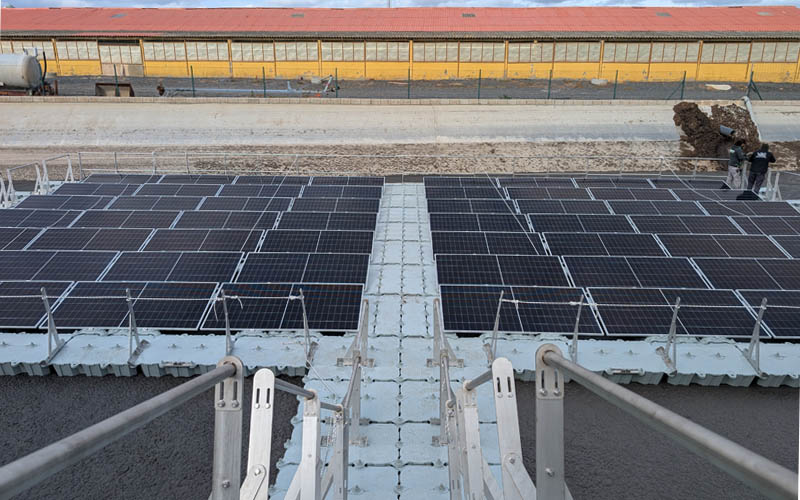
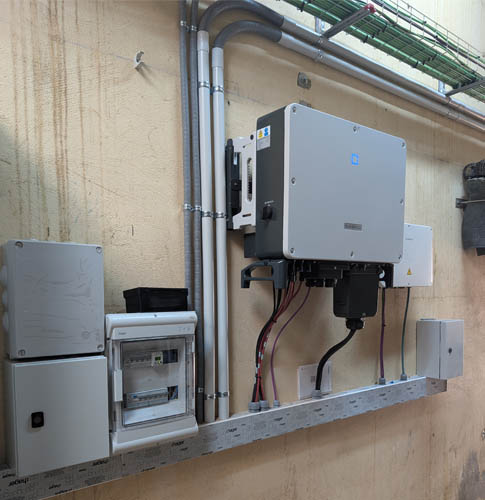
The system is designed using commercial floating photovoltaic components, with modifications to adapt it to slurry ponds. Safety features, such as an access walkway and guardrails, are included.
Dimensions: 13.5 x 25 m
Installed power: 33.04 kWp
Effective coverage: 58% of the slurry pond
Compatible with other cover elements: Yes



Custom-designed prototype

Puy Ovil Farm
Type of farm: feeding farm, isolated
Location: Costa, Tauste, 50660, Zaragoza, España
Surface area of the slurry pond: 1,100 m2
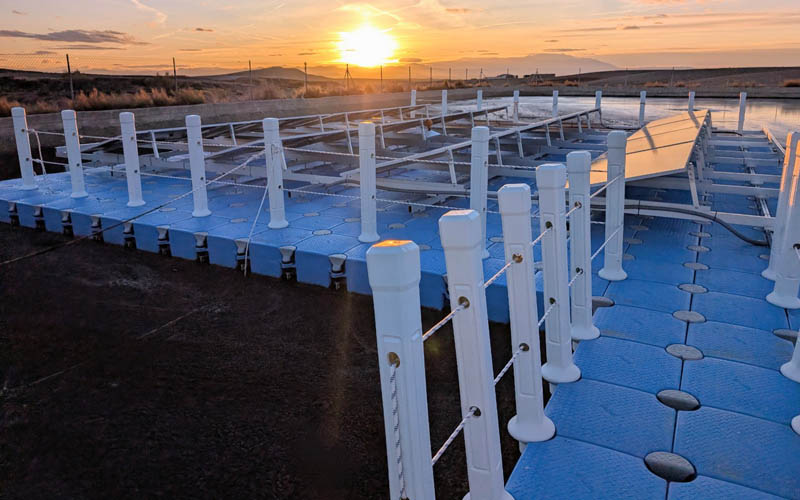
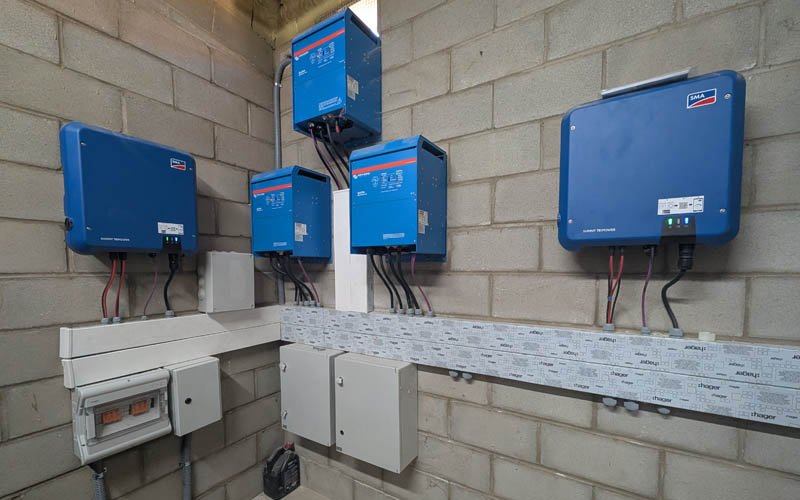
A custom-designed system for use on slurry ponds, utilizing a modular floating dock system and a metal support structure for photovoltaic panels. Safety features, such as an access walkway and guardrails, are included.
Dimensions: 11.5 x 9.5 m
Installed power: 9.44 kWp
Effective coverage: 10% of the slurry pond
Compatible with other cover elements: Yes



Project updates
The GO FOTOPUR project participated in the 45th edition of the Scientific and Technical Congress of the National Association of Scientific Swine Production (ANAPORC), held from September 29 to October 1, 2026, at the Tarragona Exhibition and Convention Center. The FOTOPUR project was presented as part of the program’s section dedicated to innovative projects, and the presentation was led by Intergia. Demonstration prototypes of the project were showcased, and preliminary results of ammonia and methane emission measurements in the ponds were shared.

Agricultural Fair and International Purebred Livestock Exhibition (Salamaq), held September 3–7, 2026, in Salamanca.
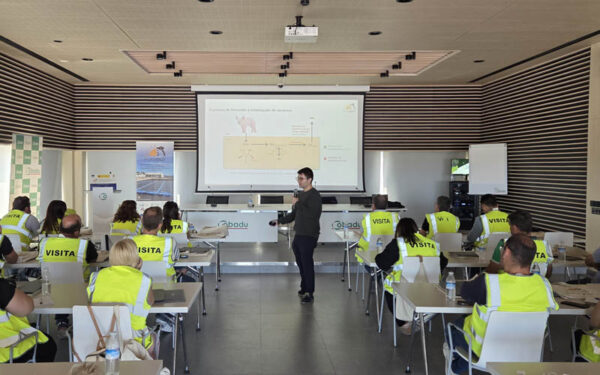
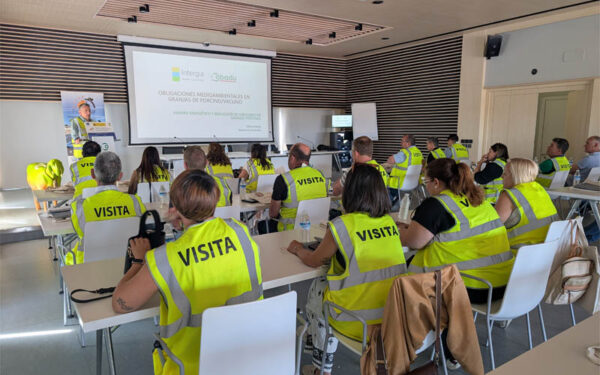
GO FOTOPUR participated in the program of technical sessions and talks with a presentation by Cobadú. The presentation showcased the latest developments and results of the project, which is nearing completion, to the attendees. A question-and-answer session followed the presentation.
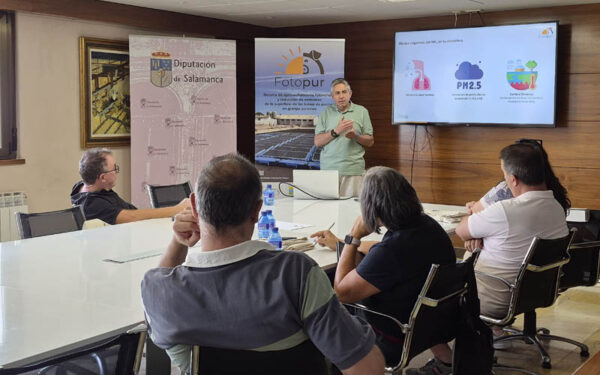
Technical Workshop: “Energy Savings and Emissions Reduction on Pig Farms” on June 10 at the Cobadú headquarters in Villaralbo (Zamora).
Nearly 40 professionals from the swine and livestock sectors learned about the latest developments in the FOTOPUR project. Alberto Megía, a veterinarian at Cobadú, provided an overview of the context of swine farms. Marcos Agudo, a project technician at Intergia, presented the demonstration prototypes at both farms to the attendees, using a series of videos and photographs. The reduction in ammonia emissions from the covered manure pit was shown for the first time, based on preliminary results obtained by the Polytechnic University of Cartagena. Jesús Yago, director of Intergia, spoke about the current state of photovoltaic energy and new opportunities for energy savings, such as the installation of batteries. Finally, attendees enjoyed light refreshments at the COBADU venue, where they continued to exchange views.
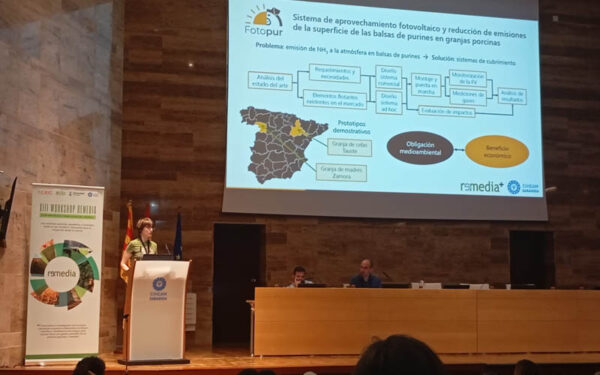
The FOTOPUR project was presented in a flash-talk format during the 13th REMEDIA Workshop, held in Zaragoza on June 3 and 4, 2026, and organized by the REMEDIA Network and the Mediterranean Agronomic Institute of Zaragoza (CIHEAM). The theme of the event was “Agricultural, Livestock, and Forestry Systems Facing the Climate Challenge: Science-Based Solutions for Mitigation.” Additionally, it was awarded the MITI prize for the best flash-talk presentation in the Livestock session.
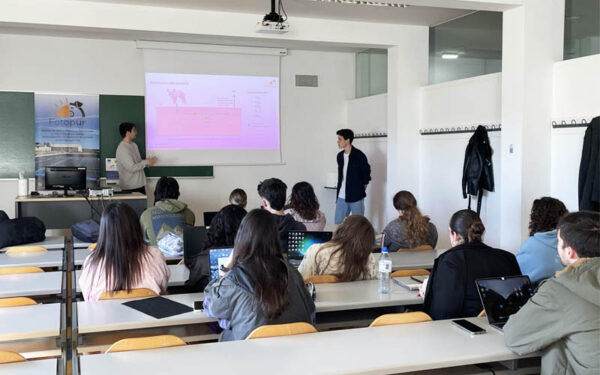
The team at Intergia has visited various departments and degree programs at the University of Zaragoza to present the FOTOPUR project: a total of 10 presentations across the Faculties of Veterinary Medicine, Economics and Business, Sciences, and the School of Engineering and Architecture in Zaragoza, as well as the Higher Polytechnic School in Huesca. Students had the opportunity to learn about this innovative solution for covering slurry pits on pig farms. Interesting discussions arose, such as the system’s cost-effectiveness and the challenges involved in its maintenance.
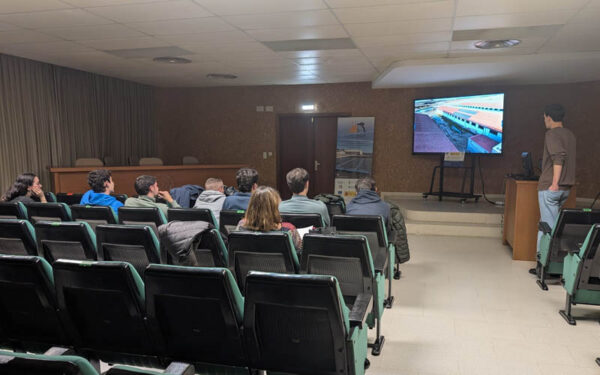
Technical Conference on “Energy Saving and Emission Reduction in Pig Farms” on February 19 in the auditorium of ADS Porcino No. 1 in Tauste.
Juan Grandía, veterinarian and president of Anaporc (National Association of Scientific Pig Farming), participated in the event, presenting the needs and challenges of the sector in terms of the environment and emissions reduction. Fernando Ederra, manager of the Tauste Manure Management Center, and Marcos Agudo, project technician at Intergia, shared the latest developments in the FOTOPUR project with attendees, showing photos and videos of the demonstration prototypes installed in the two slurry ponds. Jesús Yago, director of Intergia, spoke about the current state of photovoltaic energy and new opportunities for energy savings, such as the installation of batteries. Finally, attendees enjoyed refreshments at a nearby establishment.


The operational group presented the project and demonstration prototypes at the R&D Conference organized by the i+Porc pig cluster at the ITAINNOVA facilities in Zaragoza.
The conference was divided into three thematic blocks: the first on sector challenges and the starting point; the second, a strategic reflection on R&D in the sector; and the third block with the conclusions and closing of the conference.
Fernando Ederra, manager of Tauste Centro Gestor de Estiércoles, was responsible for presenting FOTOPUR.

The second demonstration prototype has been installed on a 6,000-head fattening pig farm in the municipality of Tauste, Zaragoza. The farm is disconnected from the electricity grid, and prior to installation it was powered by a diesel generator and a small photovoltaic system for the windows and feeders.
The slurry pond where the prototype is located has a surface area of approximately 1,100 m². A modular floating dock system consisting of cubic plastic elements that are joined together to form a platform has been used to cover it. The system chosen is BulDock Modular Floating Pontoon Docks, manufactured in Europe, which was not initially designed for floating photovoltaics. It has been adapted to include the metal support structure for the photovoltaic panels, designed specifically for this application, using anodized aluminum profiles.
The photovoltaic system has a total of 16 panels and a peak power of 9.44 kWp, facing southeast, following the longitudinal direction of the pond, and with an inclination of 15º.
The system was assembled following a procedure designed by Intergia: first, the floating platform was assembled in its entirety on a piece of land adjacent to the pond, on which boulders had been placed beforehand to facilitate sliding; then, the platform was launched onto the slurry pond with the help of an agricultural machine with a telescopic arm. Once floating, the metal structure and photovoltaic panels were mounted on the platform; the connections were made and the cable evacuation walkway was installed to the room where the inverter is located, with the cable buried in a trench, about 90 meters away.
In total, the floating platform measures 11.5 x 9.5 m and has a solar cable evacuation corridor and perimeter safety railings. The platform is positioned in an area of the pond so that it is not affected by changes in the pond’s slurry level. It is secured by four anchor points on the banks of the pond. When access to the platform is required (for maintenance tasks, etc.), the ropes are simply pulled to bring the platform closer to an access ramp provided at the pond.
The floating platform effectively covers around 10% of the pond. The expected photovoltaic production is 15.2 MWh/year, which would mean savings of up to 53% of the farm’s electricity demand, avoiding the use of a diesel generator.
Learn more about the prototype in this article.


The first demonstration prototype has been installed at a 1,400-sow farm located in Calzada de Tera (Zamora). The farm already had a photovoltaic system connected to the electrical grid to meet its energy demand. The new photovoltaic system forming part of the prototype integrates with the existing one, increasing the total capacity and the farm’s self-consumption percentage.
The slurry pond where the prototype is installed has a surface area of about 880 m². It is covered with the Lamaru commercial floating photovoltaic system by the Spanish company Landatu Solar, typically used in water ponds, adapted here for slurry ponds to ensure maximum possible surface coverage. To prevent corrosion in ammoniacal environments, all steel parts were replaced with aluminum and stainless-steel components.
The photovoltaic system comprises 56 panels with a peak power of 33.04 kWp, oriented southwest along the pond’s longitudinal direction, with a 15° tilt.
The system was assembled following the same methodology used for conventional floating photovoltaic installations on water: floats and panels were assembled row by row along the pond’s edge, then gradually pushed into the slurry pond. Before launching each row, the electrical connections between photovoltaic panels were made. A plastic sheet was used between the floats and the shore to reduce friction and facilitate sliding. Once launched, the DC cables were routed along the access walkway to the inverter room, about 80 meters away, and buried in a trench.
The floating platform measures 13.5 × 25 meters and includes an access walkway made from the same floating elements. For safety, both the perimeter of the platform and the walkway include stainless-steel railings. The structure is designed to adapt to the changing slurry level—rising or lowering with the pond’s fill level. The platform doesn’t collide with the slope, the walkway bends due to the flexibility between floats, and the moorings adjust accordingly.
To complete the system and assess compatibility, hexagonal plastic elements with ballast will be used to fill the gaps between floats and cover the remaining free surface of the pond.
With the floating platform, around 20% of the pond is directly covered, which—combined with the coverage from the hexagonal elements—will achieve over 90% total surface coverage, thus avoiding up to 90% ammonia emissions. The expected photovoltaic production is 50.04 MWh/year, representing up to 22% savings on the farm’s electricity bill.
Learn more about the prototype in this article.


Measurements of methane (CH4) in slurry ponds have begun. A specialized sensor, configured for this purpose, is used for this task. To take the measurements, the sensor has been mounted inside a plastic float with a “tub” to create a sealed static chamber, allowing the gas to accumulate until it reaches a stable concentration. To ensure the flotation and stability of the assembly on the surface of the slurry, the float was coated with polyurethane foam, a material with high buoyancy.
The first measurements, obtained over several hours, indicate a low concentration of methane emitted by pig manure. Measurements will continue throughout the year, allowing for analysis of possible seasonality in the generation of this gas.


FOTOPUR attended the 39th edition of the FEMOGA fair in Sariñena (Huesca), where it presented the project to the public.


The member of the Cobadu operational group took advantage of his training and information day to show the attendees, pig farmers associated with the cooperative, the progress of the FOTOPUR project.


The operative group presented the project and the actions developed to date at the VIII Conference on Innovation in the swine sector, organized by the A.D.S. Porcino Nº1 of Tauste, held at its headquarters in this town. These conferences act as a meeting point and transmission of knowledge between the different agents involved in the sector and pig farming professionals. More than 40 professionals from the swine sector attended these informative conferences. This year’s title was: “A safer future to discover”.


The members of the Group met at Cobadu’s headquarters in Zamora to hold a coordination meeting and visit the cooperative’s facilities. In addition, the first visit was made to one of the pig farms that will form part of the project, housing a demonstration prototype in the slurry pond.


Managing authority responsible for the implementation of EAFRD assistance: Directorate-General for Rural Development, Innovation and Agri-food Training (DGDRIFA)
Body responsible for content: FOTOPUR Operational Group


