
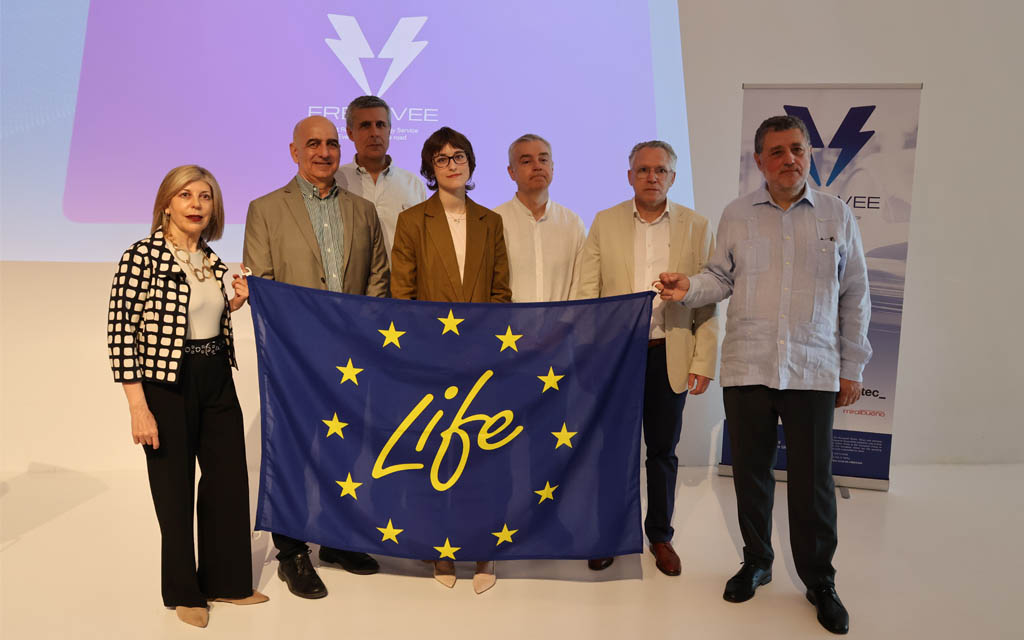
On May 29, the official launch of the European LIFE FREESVEE project (Fast Recharging Energy Service Everywhere on the Road) took place at Mobility City (Zaragoza). This initiative aims to address one of the main challenges to the expansion of electric mobility: ensuring the availability of ultra-fast charging at any point along the road network, regardless of the limitations of the existing electrical infrastructure.
The event brought together more than fifty professionals from the mobility, energy, industrial, and gas station sectors, as well as electric vehicle users, at Mobility City—a leading hub for innovation in sustainable mobility—hosted by the Ibercaja Foundation at the iconic Pabellón Puente in Zaragoza.
The event began with an official welcome address delivered by Jaime Armengol, coordinator of Mobility City; María Jesús Lázaro, CSIC’s regional representative in Aragón; and Miguel Ángel García Muro, councilor for Digital Transformation at the Zaragoza City Council. All three highlighted the strategic importance of LIFE FREESVEE in accelerating the transition toward more sustainable mobility and strengthening Europe’s technological leadership in this field.
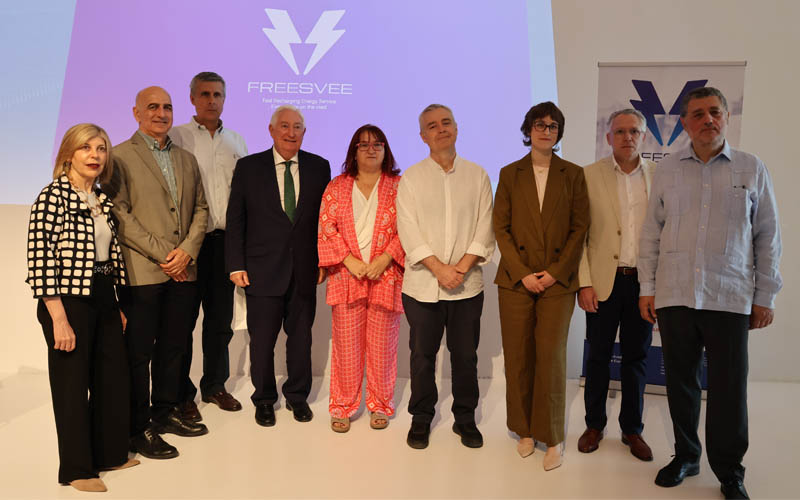
Photo of the project partners participating in the roundtable discussion with institutional representatives: Miguel Ángel García Muro, Councilor for Digital Transformation for the City of Zaragoza, and María Jesús Lázaro, CSIC representative in Aragon.
Next, the project coordinator, Dr. Javier Carroquino, and the project director, Dr. Luis Valiño, presented the main objectives of LIFE FREESVEE, a project co-financed by the European Union through the LIFE program that will run until September 2028.
The initiative proposes an advanced technological solution to enable ultra-fast public charging of electric vehicles without the need for high-power electrical connections. To this end, two demonstration prototypes will be developed at gas stations with different characteristics: an urban facility connected to the power grid in Zaragoza and a station located in an area with a weak power grid in the province of Soria.
The solutions developed as part of the project will integrate innovative technologies such as smart microgrids, energy storage using lithium-ion batteries and vanadium redox flow batteries, advanced power electronics systems, predictive control algorithms, artificial intelligence, and cloud-based energy management platforms. The goal is to optimize the use of available energy and make the deployment of ultra-fast charging stations economically and technically viable in locations where it is currently difficult or costly to do so.
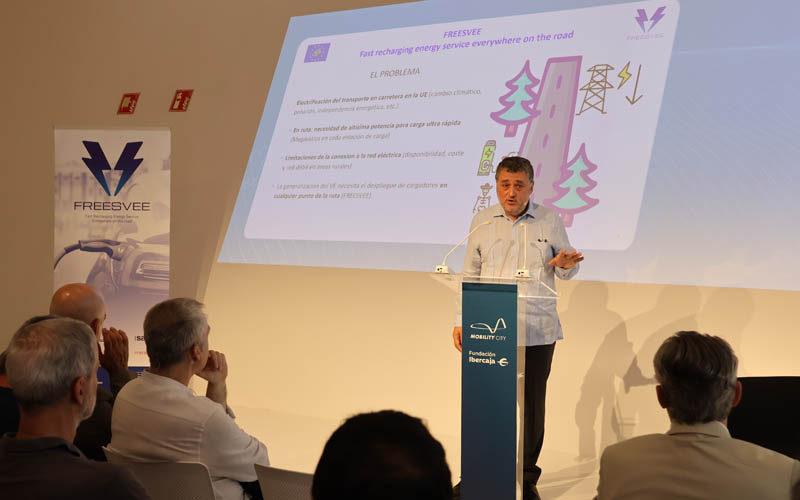
Javier Carroquino, coordinator of LIFE FREESVEE, explained the problem the project addresses and the proposed solution.
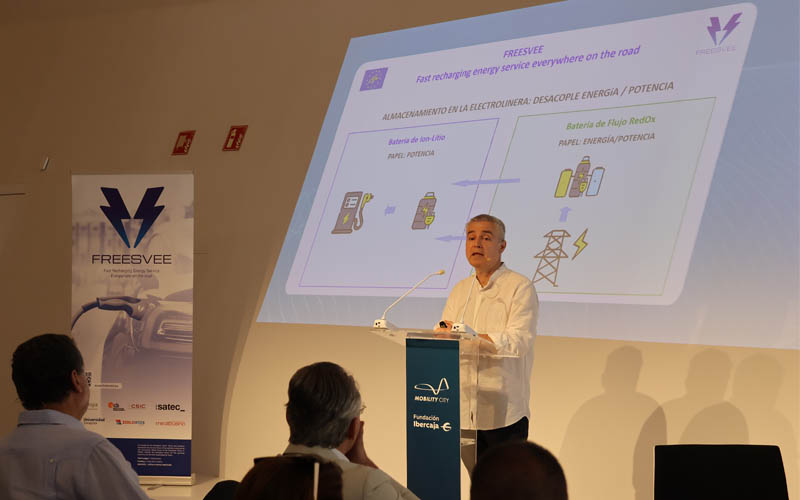
Luis Valiño, director of LIFE FREESVEE, has provided an in-depth look at the technical details of the vanadium redox flow battery to be used in one of the demonstration prototypes.
One of the highlights of the day was the roundtable discussion titled “Unlimited Electric Mobility: Smart and Sustainable Ultra-Fast Charging,” moderated by Cristina Escriche, a researcher and R&D&I project manager at Intergia. Participants included representatives from all the entities that make up the project consortium: CSIC, Intergia, SATEC, the University of Zaragoza, the Zoilo Ríos Group, and the Miralbueno Service Station.
The discussion addressed some of the most significant challenges facing the electric mobility sector and service stations, as well as the opportunities offered by emerging technologies such as energy data hubs, artificial intelligence applied to infrastructure management, smart microgrids, and vanadium redox flow batteries for long-duration energy storage.
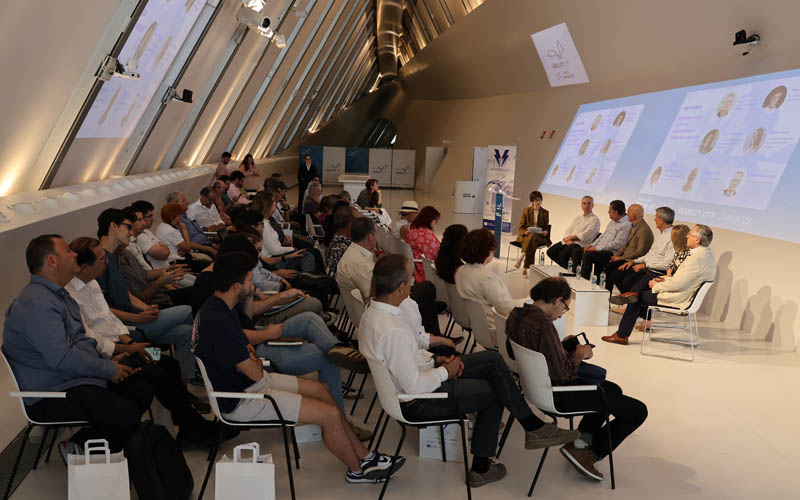
More than fifty people attended the official launch of LIFE FREESVEE at Mobility City.
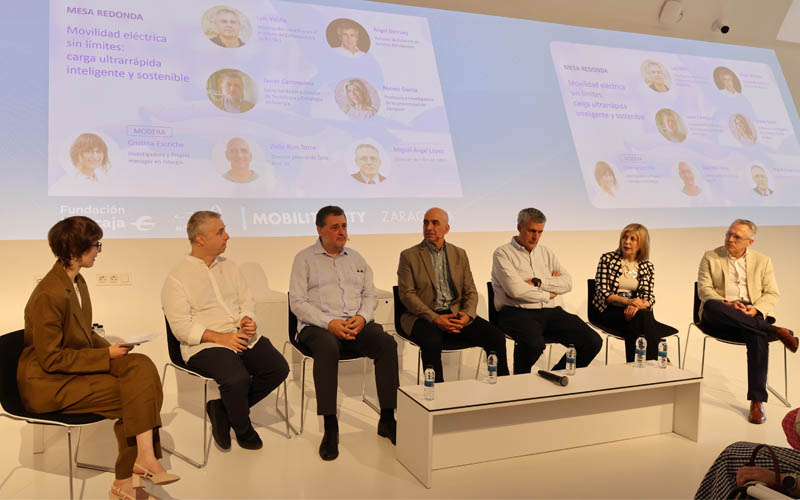
Panel Discussion: “Unlimited Mobility: Smart and Sustainable Ultra-Fast Charging.”
LIFE FREESVEE LIFE FREESVEE has a budget of over 3.6 million euros, with 60% of the funding coming from the European Union, establishing itself as one of the most ambitious initiatives in the field of advanced electric vehicle charging infrastructure. The project is coordinated by the Spanish National Research Council (CSIC) and involves the participation of Intergia Energía Sostenible, Sistemas Avanzados de Tecnología (SATEC), the University of Zaragoza, Zoilo Ríos Group, and the Miralbueno Service Station.
The event concluded with an informal gathering of attendees and participants, which provided an opportunity to continue sharing ideas and reflections on the future of electric mobility, the energy transition, and the role of technological innovation in building a more sustainable, efficient, and accessible transportation system for all of society.
With LIFE FREESVEE, the consortium is taking a decisive step toward barrier-free electric mobility, bringing ultra-fast charging to every part of the road and helping to accelerate the decarbonization of transportation in Europe.

101213372 — LIFE24-CCM-ES-FREESVEE


